
One More - Part 2
“Go and do Likewise.”

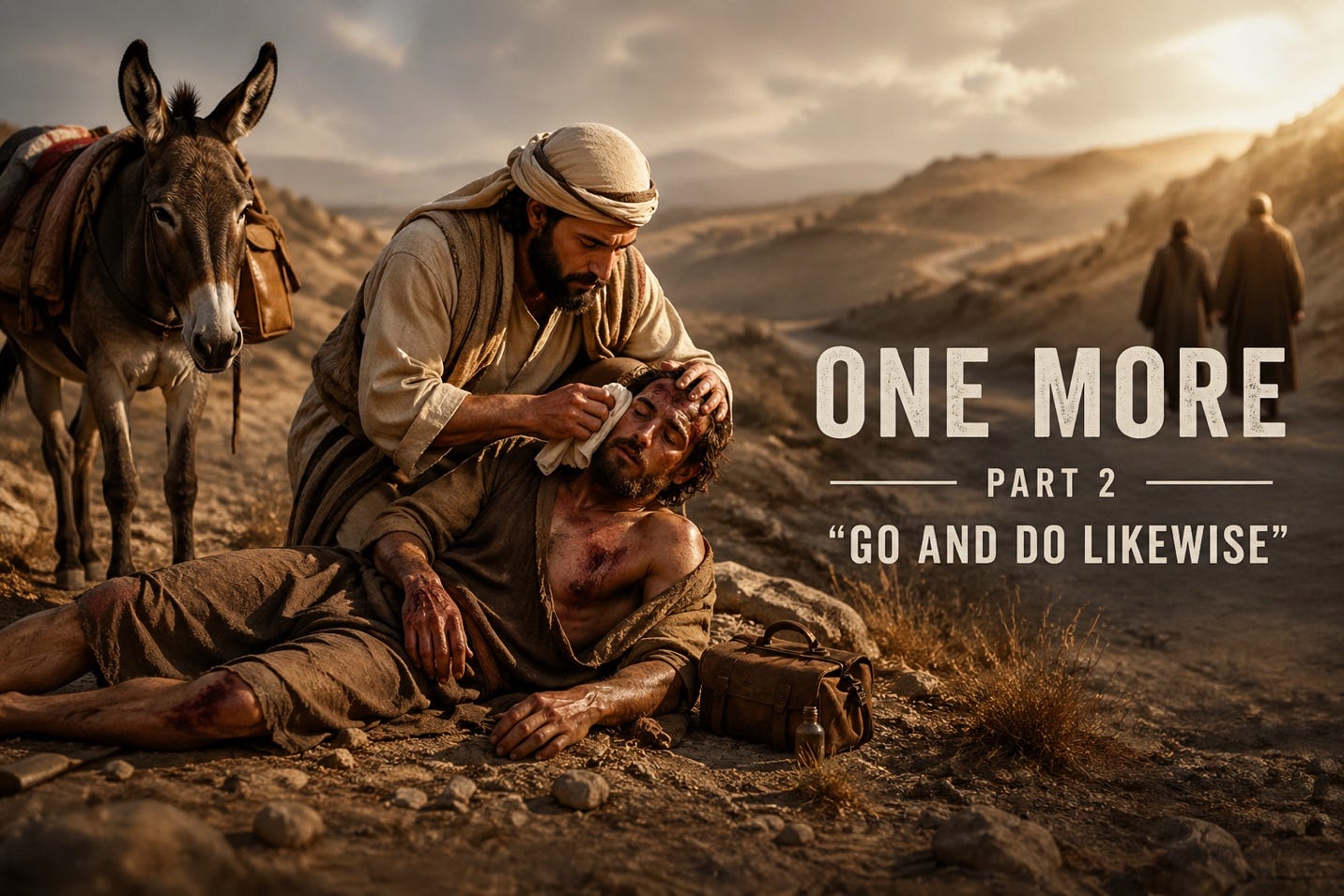
A certain man went down from Jerusalem to Jericho, and fell among thieves, who stripped him of his clothing, wounded him, and departed, leaving him half dead. Now by chance a certain priest came down that road. And when he saw him, he passed by on the other side. Likewise, a Levite, when he arrived at the place, came and looked, and passed by on the other side. But a certain Samaritan, as he journeyed, came where he was. And when he saw him, he had compassion. So he went to him and bandaged his wounds, pouring on oil and wine; and he set him on his own animal, brought him to an inn, and took care of him. On the next day, when he departed, he took out two denarii, gave them to the innkeeper, and said to him, ‘Take care of him; and whatever more you spend, when I come again, I will repay you.’ So which of these three do you think was neighbor to him who fell among the thieves?” And he said, “He who showed mercy on him.” Then Jesus said to him, “Go and do likewise.” (Luke 10:30–37)
Go and do Likewise
These words don’t drift quietly across the page; they strike with weight. They do not pass by; they remain. They press in. They echo in the heart long after they are spoken. Go and do likewise. Not go and admire, not go and analyze, and not go and agree, but go and do. And if we are honest, they are not easy words to receive. They confront us. They expose us. They leave us without excuse. These are not casual words; they are Red-Letter words, spoken by the One who did not merely tell the story, but fulfilled it. Jesus did not stand at a distance; He stepped into our brokenness. He did not pass us by; He came to us. He did not offer sympathy; He gave Himself. He bore our wounds, carried our sin, and paid the full price for our redemption with His own blood.
When Jesus says, “Go and do likewise,” He is not asking us to do what He has not already done. He is calling us to follow Him into the same kind of love.
Jesus told the account of a man left wounded on the side of the road, stripped, beaten, and abandoned. Two men passed by him, men who knew the Mosaic Law, men entrusted with spiritual responsibility. They did not miss him. They saw him clearly. They understood what was in front of them. They knew exactly what the Law required.
But somewhere along the way, knowledge had replaced compassion. They had become skilled in ministry, yet distant from mercy. What they once carried with conviction had settled into routine. Their service had become careful, measured, even polished, but no longer costly. They knew exactly what the Law required, but it never made the journey from their minds to their feet. It remained theology; correct, defined, and safely contained, yet never expressed in action. And when truth is continually known but not obeyed, something begins to harden. What should stir compassion becomes familiar. What should compel action becomes optional. The heart dulls while the mind stays informed. They kept their distance.
Not because they were ignorant, but because they had learned to live with knowledge that demanded no response. Perhaps they justified it. Perhaps they told themselves they were on their way to something important, something necessary, something “for God.” But in the process, they missed the very thing Jesus would have stopped for.
Perhaps they assumed someone else would step in, someone with more time, more margin, more availability. But in that moment, all the reasons in the world could not change the reality that a man lay wounded, and they chose not to engage.
And this is where the account stops being about them and starts becoming about us.
· It is possible to know what is right and still walk past it.
· It is possible to be involved in ministry and yet untouched by compassion.
· It is possible to carry responsibility and yet avoid the very moment that defines it.
Because the real test is not what we know. It is what we do when love requires something of us. But love does not schedule itself for later.
Then Came the Samaritan
He did not approach the moment as an observer, but as a participant. He saw the man, and he stopped. He moved toward what others avoided. He bound the wounds, lifted the man, and placed him on his own animal. He took him to a place of care and ensured his recovery, even covering the cost himself. What others passed by, he took responsibility for.
This is where the account shifts from story to confrontation. It is one thing to stop for someone in the road. It is another thing to carry them, to walk with them, and to absorb the cost of their restoration. The Samaritan did not offer a moment; he offered himself. He allowed his time, his resources, and his journey to be interrupted. Because love, in its truest form, interrupts. It interrupts what you planned to do. It interrupts where you were going. It interrupts the comfort you were holding onto. It does not wait for a convenient moment, because it rarely arrives in one. Instead, it meets you in the middle of your day, in the middle of your responsibilities, when you are already occupied and already moving.
And in that moment, a decision must be made. Will you stay on your path, or will you allow yourself to be interrupted? The Samaritan made his choice. He allowed someone else’s pain to become his responsibility. He stepped out of his own agenda and into someone else’s need. He did not pass by. He did not delay. He did not reduce the moment to sympathy. He carried. That is the law of the journey.
The measure of your love for God, for people, for the humanity to whom you are sent, is revealed in how far you are willing to go. Little love, and you will not go far. But great love… Like the song, “You will climb the highest mountain and swim the deepest ocean” …Love will do whatever it takes.
Your love determines the distance you are willing to travel.
In last week’s Substack, “One More,” we stood at a defining moment; the moment where compassion moves. We considered the account of Desmond Doss, a World War II medic who, in the middle of relentless enemy fire on Okinawa, refused to leave the battlefield while even one wounded man remained. He carried no weapon, only conviction. Again and again, he stepped back into danger, lowering injured soldiers to safety one by one, praying the same prayer:
“Lord, help me get one more.”
That was the moment of movement, where compassion sees, feels, and steps in. But what happens after that moment? What happens when compassion is no longer a decision, but a responsibility? Because stopping is a moment. Carrying is a commitment.
Doss did not stop with one rescue. He returned again and again, long after others would have withdrawn. What began as a response became a responsibility. He did not just step in; he stayed in. He did not just help; he carried. And that is where love is tested.
He Ain’t Heavy
There is an old song that has echoed through generations: “He ain’t heavy, he’s, my brother.” Made famous by The Hollies, the words carry a simple yet profound truth: when love defines the relationship, the weight of the relationship is redefined.
Behind the song is a story. During the war, a young boy was seen carrying his brother on his back. The burden was heavy, the road long, and the moment sobering. A soldier asked if he was tired. The boy replied, “He’s not heavy… he’s my brother.”
And this is where everything shifts.
When you see someone as a project, the weight feels heavy. When you see them as your brother, your sister, the weight becomes something you are willing to carry. Scripture tells us in Galatians 6:2, “Bear one another’s burdens, and so fulfill the law of Christ.” This is not a suggestion. It is the law of love, expressed through action, sacrifice, and sustained care.
This is not easy work.
It will cost you time.
It will cost you energy.
It will cost you convenience.
At times, it may even cost you safety, comfort, or recognition.
But this is the way of Christ. The road is lined with people wounded by life, worn down by circumstances, and passed by those who had reasons to keep moving. He does not measure the inconvenience; He is moved by compassion. Some need a moment of help; others need someone who will remain, who will step into their pain and refuse to walk away.
Call to Action
This is the call that remains. It is not only to notice, or to feel, or even to step in for a moment, but to carry. To carry the wounded, to carry the overlooked, to carry the burden of those who cannot carry themselves. Not for recognition or reward, not for a medal or acknowledgment, but because they are your brother, your sister, someone for whom Christ gave His life. When the moment comes, and it will, do not look away, do not delay, and do not assume someone else will step in. Be the one who does. Stay with it. Go out of your way if you must, because the measure of your love will be revealed in the distance you are willing to travel. And when the weight presses in and the cost becomes real, remember this: they are not heavy; they are your brother.
Thank you for sharing your love for the Lord through your writings. I look forward to each one.
Once again Dr. Leon you’re words are an echo of a life that we should never take for granted in our service in the Kingdom. I had to read it twice….. the second time with tears of repentance for “missing” some moments of opportunity making a difference for the One.Thank you today for the direction of discipline to deliver the undeniable love of Jesus to the ONE❤️🙏