
DISCIPLE
A convinced follower, not a comfortable spectator.

I’ve been writing this series like a man unpacking a suitcase, one word at a time.
First came Believer.
Then Christian.
Now we arrive at a word that makes demands and allows no half-measures: Disciple.
Not a label.
Not a category.
A summons.
Disciple is dangerous by definition, because it refuses to stay in the neat compartment we built for religion. It does not negotiate for your Sundays; it lays claim to your entire being.
It doesn’t merely ask what you believe; it presses you on what you obey.
It doesn’t just warm the heart; it rearranges schedules, reshapes habits, governs words, touches the bank account, and sometimes even reroutes travel plans.
And that is why this question keeps tapping me on the shoulder, like a persistent child in the back seat:
AM I A CHRISTIAN, OR A DISCIPLE?
The first believers were called “disciples” before they were called “Christians.”
Acts 11:26 says, “…and the disciples were first called Christians in Antioch.”
That means “disciple” was the normal word before “Christian” became the label.
Over time, the label expanded, and its meaning blurred. Today, Christian can mean almost anything. In some places, it means, “I was born in the right country.” In others, “I try to be a decent person.” In many cases, it means, “I go to church when I can,” which, when translated, often means, “when nothing else is happening.”
But disciple has never been flexible. It has never meant casual, cultural, or convenient. Disciple has always meant a convinced follower, one who orders life around the voice of a master.
In the city of Antioch, “Christian” likely began as a nickname, possibly even a jab. “Those little Christs,” or “those Jesus people.”
But the irony is that the name was more accurate than the mockers realized. Christian carries the idea of belonging to Christ. In common usage, it came to describe people identified with Jesus, marked by His life, His Spirit, and His mission.
What may have been intended as an insult turned out to be a compliment.
So yes, ask, “Am I a Christian?” But then ask the sharper question: Am I a disciple?
They are meant to describe the same person. A Christian cannot honestly say, “I am not a persuaded follower of Christ.” A disciple is a convinced follower, not merely a curious admirer.
In the ancient world, a disciple was not a casual attendee. A disciple was an adherent, a devoted student who didn’t just collect information but imitated the teacher’s life and embraced the teacher’s cause. John the Baptist had disciples (John 1:35–38). They learned his message, his posture, his holy seriousness. When Jesus called people to become His disciples, they not only listened to His teaching but also joined the continuation of what He began, both to teach and to do.
Because the terms “disciple” and “Christian” are often used interchangeably, I want to clarify how I’m using them here.
The Disciple refers to the private, inner work of formation. This includes training, spiritual development, godly character, and convictions that become habits.
The Christian refers to the public expression of that inner life, the believer’s calling, gifts, obedience, and visible witness, empowered by the Spirit.
These two are not in contradiction. They are not in competition. They are meant to be held together, producing a stable believer. A strong public life without a deep private life leads to imbalance and, eventually, collapse. A deep private life, with no outward obedience, can lead to imbalance and eventually stagnation.
If you want a simple summary:
100% disciple and 100% Christian. This is balance.
Inner life and outer life
Formation and fruit
Word and work
Prayer and purpose
THE CALL OF GOD TO MAKE DISCIPLES
Matthew 28:18–20 is not complicated, but it is confronting. Jesus gives the central command, then surrounds it with supporting actions. The Great Commission is a call to not merely to “make converts,” church attendees, or followership on their terms. The Great Commission is the calling to “make disciples.”
The mission of the Church, every local church in every nation, is the Great Commission. No exceptions. Which means every believer is included in becoming a disciple and in helping others become one.
I love the flock. I’ve spent my life caring for believers, training leaders, mending wounds, and guarding doctrine. Shepherding matters. But if we are honest, much of the modern church is excellent at gathering people and weak at forming disciples. We can grow crowds, fill calendars, and create attendees. The harder question remains: Are we making disciples?
Let’s make this personal:
Who have you recently reached with the gospel?
Who are you discipling right now?
If the answer is, “I’ve been meaning to,” you’re not alone. But intention is not obedience. We are not saved by these efforts, yet the Great Commission must remain our mission.
THE FIRST MARK OF A DISCIPLE: A WILLINGNESS TO ABANDON ALL
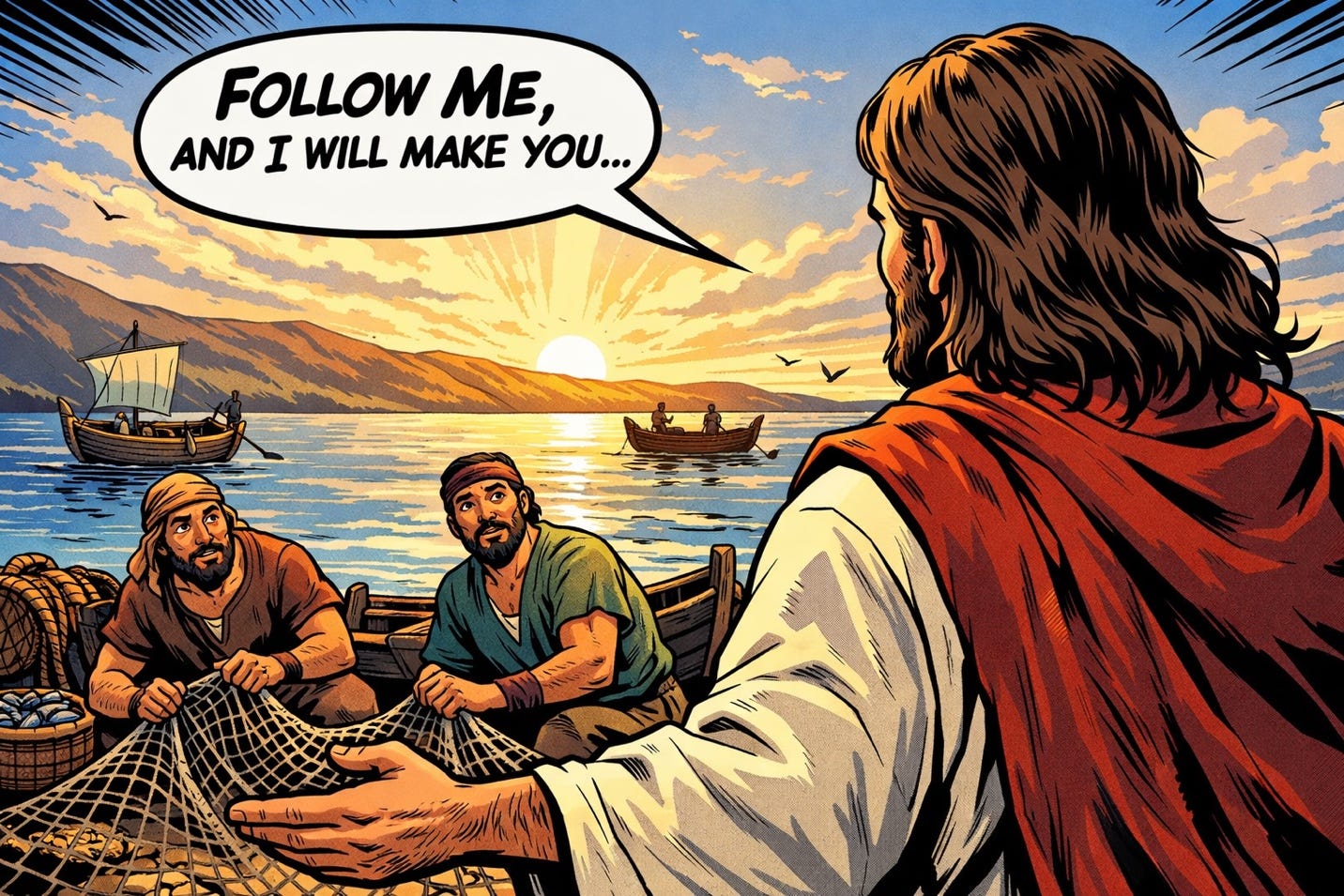
Jesus walked by the Sea of Galilee and called fishermen who were mid-career, mid-responsibility, mid-life. “Follow Me, and I will make you fishers of men.” They left nets, boats, and even family business structures behind (Matthew 4:18–22; Luke 5:1–11). Then Matthew, sitting in a tax office, heard the same words: “Follow Me.” He got up and walked away from his income stream (Matthew 9:9).
This is where discipleship begins and continues: Jesus has access to all. We hold nothing back. Now, that does not always mean you leave your job, sell your home, and relocate to a desert. Sometimes it means you stay and obey Him there. But the heart posture is the same: “Lord, everything is Yours.”
Here is the paradox, and it is one of the happiest paradoxes in the Kingdom:
When we abandon all to Jesus, we do not lose; we gain.
Jesus said it plainly: those who leave for the sake of the Kingdom receive “many times more” in this present time, and eternal life in the age to come (Luke 18:28–30). He is not a taker. He is a giver. He is not trying to impoverish your life; He is trying to enlarge it.
DISCIPLESHIP INCLUDES A SENTENCE SOME AVOID: “COUNT THE COST.”
Luke 14:25–33 is not a gentle devotional for people who like soft music and warm lighting. Jesus turns to the crowds and essentially says, “If you want to follow Me, sit down and do the math.” Are you really willing to finish what you have started? Can you see this through to completion? He gave two pictures: building a tower, and a king going to war. Can you finish the project and pay the price? Can you win this war? When He uses the war analogy, it is almost humorous in its bluntness. It is as if Jesus is saying, “If you are planning to fight God for control of your life, you are not a brave rebel; you are a confused man with a stick challenging a tank.”
Many gospel presentations invite people to pray and receive salvation, but don’t teach those who receive how to move from convert to disciple. The result is a church full of spiritual infants who know how to receive, but not how to follow. They follow Jesus as a crowd followed Him: to be fed, healed, helped, and inspired. But when the call becomes costly, they drift away. They view this “Count the Cost” as radical rather than the normal Christian life.
Don’t fight God; you will lose.
Don’t negotiate discipleship on your terms; you will lose.
His terms are gracious, but they are still His terms.
DENY YOURSELF: DISCIPLESHIP IS NOT BEHAVIOR MODIFICATION, IT IS THRONE REPLACEMENT
Luke 9:23–26 presses deeper: “Let him deny himself, take up his cross daily, and follow Me.”
Christianity is not simply “stop doing bad things.” If it is only that, we produce polished sinners with religious vocabulary. New birth is a miracle of transformation. The old self, enthroned, is dethroned. We abdicate. We hand over the rule to Christ. We are not saved by discipleship, but salvation produces discipleship. Grace does not remove obedience; it produces it.
Paul wrote, “The love of Christ compels us… that those who live should live no longer for themselves, but for Him” (2 Corinthians 5:14–15).
A few questions that only you can answer for yourself:
Are you willing to no longer live for yourself?
Are you willing to deny yourself?
This is why discipleship is ultimately not driven by guilt, performance, or compliance; it is driven by love. Love compels. Love moves. Love sacrifices. Love is the motive of the authentic disciple.
THE “HATE YOUR FATHER AND MOTHER” PASSAGE, EXPLAINED WITHOUT PANIC
Luke 14:26–27 is one of those texts people either ignore or misuse. Jesus says if you don’t “hate” father, mother, wife, children, even your own life, you cannot be His disciple.
He is not commanding emotional cruelty or family abandonment. He is using a comparison so strong it shocks us awake. He is saying: Your love for Me must be so supreme that every other love, by comparison, looks like hatred.
In other words, Jesus is not teaching you to love your family less in a sinful way; He is teaching you to love Him more in a holy way. And when you love Him most, you actually love your family better, because you are no longer asking them to be your god.
CARRY YOUR CROSS DAILY: THE DEATH THAT LEADS TO LIFE
A cross in Roman culture was not considered jewelry worn around the neck. It was not a logo. It was a public execution device. “Carry your cross” meant “walk toward death.”
In light of this definition, what does it mean for us? It means we surrender plans, ambitions, and rights to Christ’s Lordship. It means we are willing to endure shame, inconvenience, misunderstanding, and sometimes real opposition for the sake of obeying Jesus.
And I want to say this carefully: this is not a gloomy life. This is not a “God wants me miserable” gospel. The cross is death to self, yes, but it is also the doorway to joy that self could never produce.
Some of the happiest people I have known have been the most surrendered people. They were not happy because life was easy; they were happy because their life was owned by a greater purpose.
A DISCIPLE ABIDES IN THE WORD, NOT VISITS IT
Jesus said, “If you abide in My word, you are My disciples indeed” (John 8:31).
Abide is not a weekend rental. It is not a hotel stay. It is home. It is where you live.
We read the Word like daily bread. We study to handle it accurately. We meditate. We speak it. We do it.
And yes, I know, sometimes reading Leviticus feels like walking through a museum at the pace of a tortoise, 6with a tour guide who keeps stopping at every lampstand. Still, disciples abide.
Because Scripture does something no motivational talk can do: it renews the mind, anchors the conscience, strengthens the inner man, and trains our discernment.
A disciple doesn’t merely want a verse to post; he wants a life to build.
A DISCIPLE LOVES OTHERS, LOUDLY
Jesus did not say, “They will know you are My disciples by your arguments.” He said, “By this all will know that you are My disciples, if you have love for one another” (John 13:35).
Power matters. Gifts matter. The supernatural is real. But our greatest reputation is not signs and wonders, it is love. And this is where we must be honest. There is too much division in the family of faith. Too many offended believers. Too many spiritual “friendly fire” incidents. If you have been harmed by another Christian, forgive them. Not because what they did was small, but because what Christ did was greater. Love is not denial; love is obedience. Love is evidence that the Spirit is at work in us.
A disciple produces unity. A disciple refuses the poison of envy and the hobby of scandal. A disciple builds rather than bites. And when the church loves well, the church becomes what it was always meant to be in a violent world: a refuge, a beacon, a family.
A DISCIPLE BEARS FRUIT, AND FRUIT IS MORE THAN “NICE PERSONALITY.”
Jesus said, “By this My Father is glorified, that you bear much fruit; so you will be My disciples” (John 15:8).
Fruit includes the fruit of the Spirit, yes. Love, joy, peace, patience, kindness, goodness, faithfulness, gentleness, self-control. These are not optional accessories; they are evidence of the Spirit’s life.
But fruit also includes the overflow of obedience:
Lives reached with the Gospel,
Believers strengthened,
Prayers that change environments,
Giving funds for the harvest,
Serving that builds the church,
Sacrifices that make room for others to live.
Fruit is what grows out of abiding. It is what happens when the private life becomes real, and the public life becomes faithful. And here is a line I keep returning to, because it corrects two errors at once:
We are not saved by fruit, but we are saved for fruit.
Grace saves us, and grace trains us.
RESET TO THE BLUEPRINT
Jesus began His ministry with, “Follow Me, and I will make you…”
He ended His earthly ministry with the words, “Go and make disciples…”
That is our mission today. Not merely to raise hands in services, but to raise disciples in life. Not merely to fill seats, but to form saints. Not merely to produce converts, but to produce convinced followers of Jesus Christ.
So, am I a Christian?
I pray so, in the true sense, not the cultural one.
But the question that does not let me remain comfortable is this:
Am I a disciple?
Not do I admire Jesus.
Not do I agree with Him.
But am I following Him?
A disciple is a convinced follower of Jesus Christ, one who obeys, abides, loves, bears fruit, and joins the work He began. Not perfectly, but genuinely. Not without struggle, but without reserve.
This is not condemnation; it is confrontation. And confrontation, when it comes from Christ, is always an invitation to alignment, to life, to freedom.
A disciple is not someone who never stumbles. A disciple is someone who keeps following. And if you are willing to say, “Lord, You can have access to all,” then you are not far from the Kingdom life Jesus promised. Because discipleship does not begin with strength, it begins with surrender.
Jesus is still saying what He has always said:
Follow Me.
And He is still making the same promise:
I will make you.
YES! To many people stop at Justification (accepting Jesus) and don't go on to Sanctification where we are becoming like Christ as a disciple. I wrote a post on Sanctification but it wont be coming out for a few weeks yet. Here is what it says (if your interested): “For this is the will of God, your sanctification.” — 1 Thessalonians 4:3
Position vs. Progress
In our post last Monday, we looked at Justification—the moment God declares us righteous because of Christ. It is a one-time legal act. But many people stop there. They treat their faith like a “fire insurance policy”—something they’ve signed but never actually live out.
If Justification is being assigned a new identity, Sanctification is the lifelong process of learning to walk in it. To understand how we grow, we have to look at the two sides of a holy life:
The Power: The Holy Spirit’s work within us.
The Participation: Our daily surrender and “working out” of that power.
The Marathon vs. The Sprint (The Heart of the Process)
To understand the “how” of your growth, think about the difference between a one-time sprint and a lifelong marathon. The Bible encourages this perspective in Hebrews 12:1: “...let us also lay aside every weight, and sin which clings so closely, and let us run with endurance the race that is set before us.”
The Sprint Life (The Trap): This is the belief that sanctification should happen all at once. You expect a “bolt of lightning” to take away every struggle. When you realize you still face temptation, you fall into the “Discouragement Trap,” wondering if your justification was even real. This faith is based on an expectation of perfection rather than a commitment to the process.
The Marathon Life (The Reality): This is a faith that understands growth is progressive. You aren’t “sinlessly perfect,” but you are “sinning less.” You recognize that while you are already positionally holy in God’s eyes, you are progressively becoming like Jesus in your character. This faith is secured by the Spirit’s endurance, not your own speed.
When you view sanctification as a marathon, the “Legalism Trap” disappears. You stop trying to “perform” for God’s favor and start “participating” in His power.
The Evidence: Why Participation Matters
Understanding that sanctification requires our active surrender changes how we look at our daily walk. As Philippians 2:12-13 says, “Work out your own salvation with fear and trembling, for it is God who works in you...”
Surrender over Willpower: True growth isn’t about “trying harder” through human grit; it’s about “yielding more.” If you try to change through willpower alone, you fall into the “Self-Help Trap,” which leads to pride or burnout.
Conviction over Condemnation: In sanctification, the Holy Spirit will convict you of sin. This isn’t God being angry; it’s a Father pruning a branch so it can bear more fruit. Condemnation drives you from God; conviction draws you to Him.
Hatred of Sin over Habit of Sin: You know you are being sanctified not when you never stumble, but when stumbling breaks your heart. You move from “managing” sin to truly “turning away” from it.
The Invitation: Living as a Work in Progress
The unmerited nature of Grace doesn’t just save us for heaven; it changes us on earth. Real sanctification doesn’t mean you’ll never face another battle; it means you are no longer fighting that battle alone. You are a “new creation” in the middle of a messy transformation.
My hope for you this week is that you would stop looking at your failures and start looking at your Shepherd. Ask yourself: Am I participating in the Spirit’s work, or am I still trying to run the race in my own strength?
Application & Prayer
Reflection Questions:
Do I fall into the “Legalism Trap,” thinking God is only happy with me on the days I “perform” well?
Can I see a “decreasing frequency” of old sins and an “increasing hatred” for things that grieve God?
Am I waiting for a feeling to change me, or am I actively “working out” the salvation God has put in me?
Practical Step: Today, identify one “old habit” or thought pattern. Instead of just trying to stop it, ask the Holy Spirit to replace that desire with a new desire for His Word.
Prayer: Heavenly Father, thank You that You aren’t finished with me yet. Thank You for the gift of Your Spirit who empowers me to grow. Help me to avoid the traps of pride and discouragement. Teach me to walk in the “Marathon” of sanctification, trusting that You will complete the good work You started in me. Amen.
Great Word Dr. Leon. It certainly helps to remove the "guesswork" whether one is totally surrendered to Jesus as a disciple or whether one is even a true Christian. In reading this, I still have much work to do. Blessings