
BEHOLD THE EMPTY TOMB
“The Tomb Is Empty. He Is Risen”

The atmosphere had changed…
It wasn’t obvious at first. There was no single moment you could point to, no clear line between what had been and what now was. But something had shifted. The air itself felt different, as though the city had exhaled and forgotten how to breathe again.
Only days earlier, the streets had throbbed with noise. A procession had surged through them, loud and chaotic, filled with voices layered on top of one another in a language the boy did not fully understand. There had been shouting, laughter, anger, and confusion. Dust kicked up under hurried feet. The sharp smell of sweat and tension. And at the center of it all, the image that refused to leave him, the man they called King, hanging on a cross.
Not like any king he had imagined. Not crowned in gold or seated in power, but broken, bleeding, lifted up for all to see.
Something Has Shifted
Since that day, the noise had drained from the city. The streets were still, but not peaceful. It was the kind of quiet that presses in on your ears, that makes every footstep sound too loud. Conversations were shorter now, hushed. People moved differently, as if carrying something unseen but heavy. It felt as though something had been taken out of the city, leaving behind an emptiness no one could name.
The boy felt it, though he could not explain it. And so, he did what boys do when the world becomes too heavy to hold; he left it behind. He slipped beyond the gates, out past the worn paths and scattered stones, to the place where the tombs of the wealthy were carved into the rock. The air there was cooler, quieter. Sound seemed to disappear before it could travel. Time itself felt slower, as if the world had paused and forgotten to start again.
He stooped and picked up a stone, rolling it in his palm to feel its weight. It was familiar. Solid. Obedient in a way nothing else was. He fixed his gaze on a mark cut into the pale hillside. Like boys do, he pictured the future as simple and certain, bright with heroics. One day he would be strong enough, skilled enough, brave enough. He would drive out the Romans. He would give the Holy City back its freedom.
He set the stone in the sling, drew it tight, and held his breath. He thought of King David as a boy facing a giant, then let the cord slip. The stone tore through the quiet, sharp and clean. It struck with a hollow crack that bounced off the tombs and died into stillness.
And then, footsteps. Fast. Urgent. Breaking the quiet like a tear through cloth.
The boy turned.
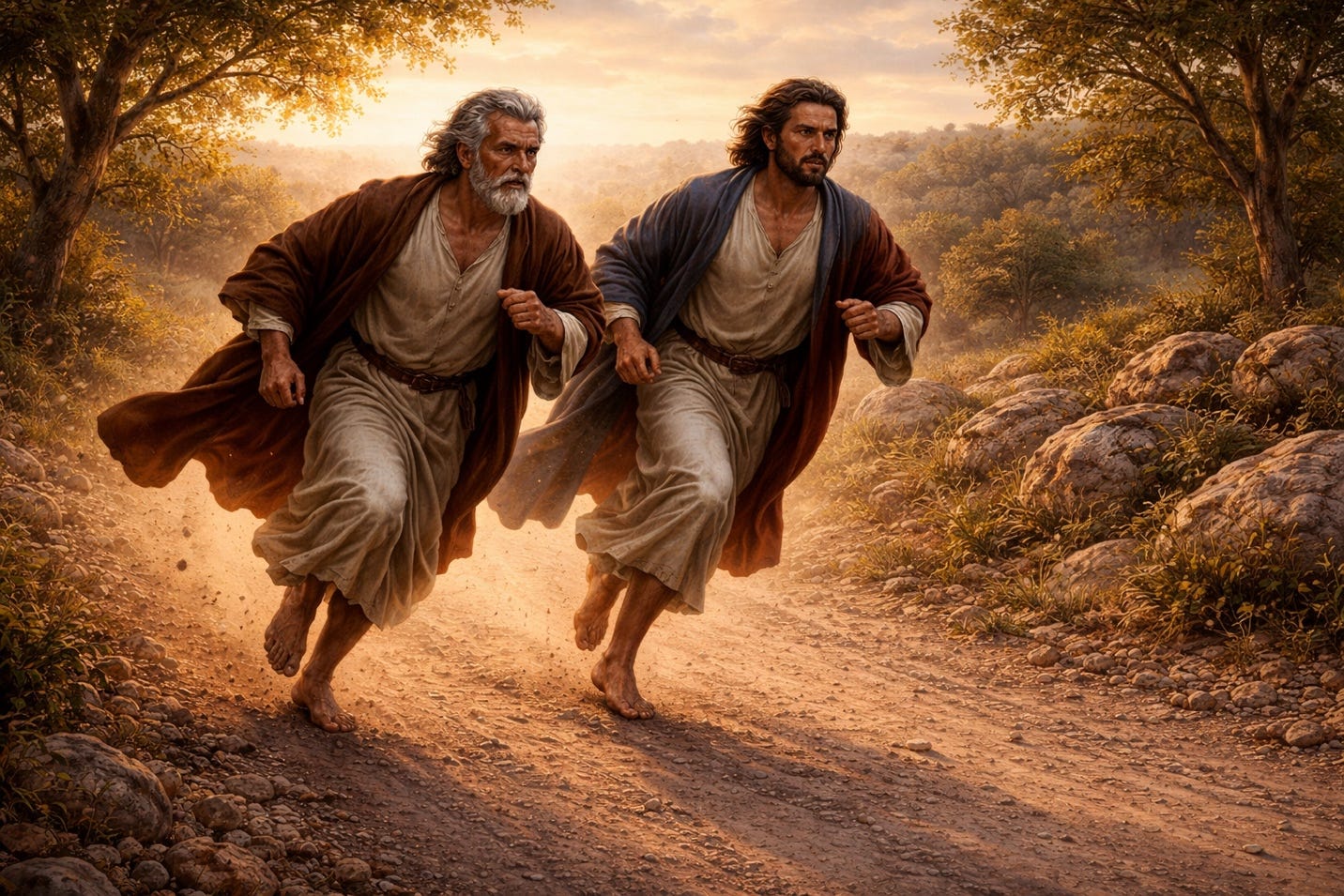
Two men were running along the path that wound past the tombs. One younger, quicker, his stride long and determined, pulling ahead. The other runner was older, heavier, his breath uneven, pushing himself to keep up.
“Slow down!” the older man called, his voice thin with strain, snagging in the air. But the younger man didn’t turn. Didn’t break stride. “He’s not here!” he shouted back. The words hung there, as if the morning itself were holding them in place. The boy stopped. The sling slipped loose in his hand. Not here?
The younger man reached the tomb and pulled up short at the entrance, as though something unseen barred his way. He bent, peering into the dim, but did not step inside. A moment later the older man caught up, breath ragged. He didn’t hesitate. He brushed past him and went straight in, swallowed by the dark.
The silence returned, but it was no longer the same. The boy stepped forward. Then again. Something had happened here. Something no stone, no weapon, no uprising could ever accomplish. The tomb was empty. He had risen… just as He said.
The boy stood there, the sling hanging loose at his side, forgotten. The dreams he had carried out here, the ones shaped by strength and defiance, by visions of overthrow and victory, suddenly felt smaller than they had just moments before. Not wrong, exactly. But incomplete. As if they belonged to a world that no longer quite existed.
He didn’t reach for another stone.
He didn’t reset his stance or search for another mark.
At the Edge of the Tomb
He just stood there, fixed in place, his eyes drawn again and again to the mouth of the tomb. Trying to make sense of what he knew, and what he had just heard, and what now stood in front of him like a question too large to answer. As the reality began to settle over him, it was as though the question itself hung in the air, unspoken but unmistakable: Why do you seek the living among the dead? He is not here… He has risen.The words didn’t just explain the moment. They redefined it.
He had seen the King, though he hadn’t understood Him. He had stood at the Cross, though he hadn’t known what he was witnessing. And now he stood before an empty tomb, where absence somehow spoke louder than anything he had seen before.
Something in him was shifting.
Until now, he had only seen these things the way anyone might see them, passing by, taking notice, carrying the memory without letting it carry him. But this was different. The moment was no longer something outside of him. It had come close. Too close to ignore.
He was no longer just seeing.
He was beginning to behold.
And this is where it meets us.
Because it is possible to know this story and still remain at a distance from it. To speak about the Cross with familiarity, to celebrate the resurrection with conviction, and yet never allow it to press in, to unsettle, to change us. We can carry the language of it without ever stepping into the weight of it.
But to behold is something else entirely.
To behold is to stand where explanation runs out, and realization begins. It is to come face to face with what the resurrection is actually saying, not just what we have learned to say about it. It is to recognize that Jesus is not held in memory, not confined to history, not reduced to an idea we can reshape or revisit when it suits us, but alive.
And if He is alive, then nothing remains untouched.
It means sin has not simply been addressed but dealt with. That death has not been postponed but overcome. The grave does not wait patiently at the end of all things but has already been emptied of its final word. And it means that the power that raised Him is not distant or sealed away in the past, but present, active, and calling even now.
The Cross already asked something of you.
The empty tomb removes every place left to stand in between.
You may try to explain it, to soften it, to keep it at arm’s length, but it does not stay there. It refuses to remain an idea. It presses closer. It insists. Because if He is risen, then this was never a metaphor or poetry. “I am the resurrection and the life,” He had said. Not pointing to something beyond Himself, but declaring that life, real, unending life, was found in Him. And if what He said is true, then your life cannot remain as it was.
So, to behold the empty tomb is not as a location to visit in your mind, but a declaration that reaches into your life. Not as a moment that happened, but as a reality that continues. Not as something to admire from a safe distance, but as something that calls you forward. It means death is no longer what it once was. Christ, raised from the dead, will never die again; death no longer has dominion over Him. The grave has lost its authority, its final say, its claim.
“O death, where is your sting?
O grave, where is your victory?”
And you may find yourself, like that boy, standing still in the middle of it, still holding what once made sense. Old definitions of freedom. Old measures of power. Old ways of seeing.
And realizing, slowly but unmistakably, that they no longer fit in your hands the same way.
This Changes Everything
So don’t just see it.
Don’t just agree with it.
Don’t just celebrate it.
Behold.
Stay there long enough for it to reach you…
for it to confront you…
for it to change you…
Because when you truly behold, you cannot remain the same.
And in beholding, believe.
And in believing, live.
He is risen.
He is risen indeed.
“To behold is to stand where explanation runs out, and realization begins.”
Your message is so inspiring. I am a better person because “BEHOLD” is now in my life especially at this moment in time. Ty Dr Leon