
A QUICK WORK
Nehemiah led the people to rebuild the walls in 52 days

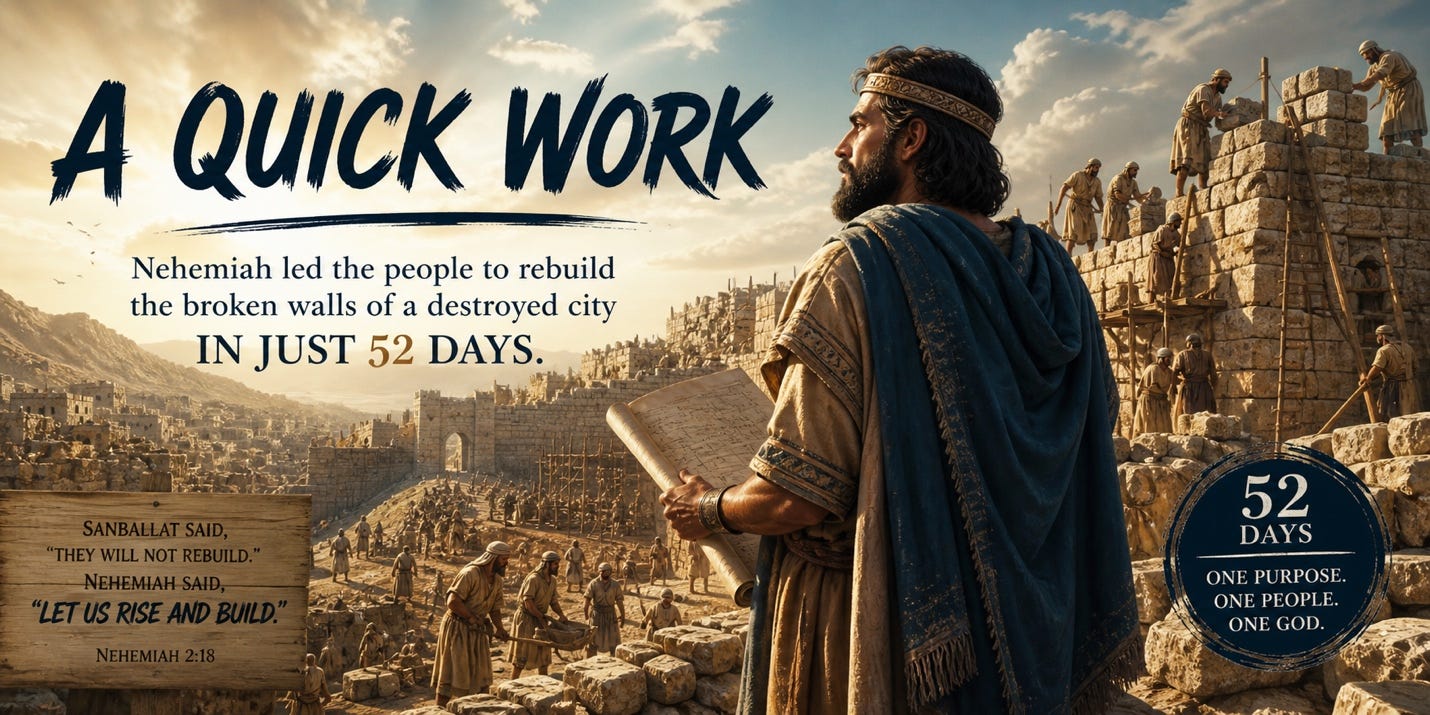
My most favorite Bible verse may sound a little unusual at first glance: “So the wall was finished on the twenty-fifth day of Elul, in fifty-two days.” (Nehemiah 6:15)
This fav Scripture doesn’t exactly show up printed on coffee mugs. Neither will you find it printed on a t-shirt or quoted at a wedding. It doesn’t carry the poetic beauty of John 3:16, nor the personal lift of Philippians 4:13. At first reading, it sounds more like a construction report than a life verse. And yet, this verse grips me. Because tucked inside that simple statement is something powerful. Fifty-two days. Not fifty-two years. Not “someday.” Not “we’re still working on it.” A broken city. A scattered people. Opposition on every side. And then, suddenly, completion.
This verse is marked by urgency, purpose, and focus. A man refused distraction. A people caught the vision. And God moved when their hearts aligned. It reminds me that when God finds a yielded life, the impossible doesn’t just begin, but it gets finished in 52 days. And that, to me, is deeply stirring.
Can God find your life yielded to Him today? His eyes still search to and fro, looking for a heart that is fully surrendered, a worshipper who is His in truth. He is not looking for perfection, but for availability; not for strength, but for willingness. My aim in writing this article is to help position you to step into something far greater than yourself, so that, like Nehemiah, you may be entrusted with both a quick work and a great work.
OPPORTUNITY TO DO A GREAT WORK NORMALLY COMES WITH A CRISIS
It began with a simple question. Nehemiah asked one of his brethren, in essence, “What’s happening back home?” or for a South African, “Howzit?”, or as Scripture records it, “I asked him concerning the Jews who had escaped, who had survived the captivity, and concerning Jerusalem.” (Nehemiah 1:2) It was an ordinary question, the kind you ask in passing. But it unlocked an extraordinary moment. When Hanani answered, the report didn’t just inform Nehemiah; it broke him. “The people who returned are barely holding on. They are struggling…living in hardship and disgrace. The walls of Jerusalem are still in ruins. The gates are burned. What entered his ears did not stay in his mind; it pierced into the depths of his heart.
“I sat down…” not casually, but because the weight of it, he collapsed. “I wept!” He did not weep briefly, but deeply and for days. This was not a passing emotion, but a burden that stayed with him. He fasted and prayed earnestly as he carried it before God. This is where everything began to change. What started as information became intercession. What felt like sorrow became direction. The opportunity to do a quick and a great work rarely arrives in comfort; it usually comes wrapped in crisis. While others hear the mere audio and move on, he heard God.
Nehemiah was not called through an angel, an audible voice, a dream, or any dramatic encounter. He heard about a broken city and a demoralized people, and he decided to act. God did not call him in the way we often expect. Nehemiah answered because God was already working in him, both to will and to do. When the moment came, he said yes. He moved from comfort to calling, from routine to responsibility. And through that surrendered life, a broken people rose, a ruined city was rebuilt, and in fifty-two days, what seemed impossible was finished.
Nehemiah didn’t go searching for a great assignment; it found him in the form of broken walls and a disgraced people. And in that moment, God was not just revealing a problem; He was awakening a purpose.
This is often how God works. The opportunity to do a great work rarely arrives in comfort. It comes disguised as a crisis, a problem, a burden that others have learned to live with. It shows up at the point of tension, when something is clearly broken, and no one has stepped forward to address it.
Scripture reveals this pattern again and again. David did not step into his destiny on a quiet day playing his harp in the fields. His moment came when a giant stood defying the people of God, and an entire army stood paralyzed in fear. What others avoided, he confronted.
Gideon did not discover his calling in a place of strength, but in weakness. He was hiding, afraid, trying to survive, while the oppression of the Amalekites had reduced Israel to desperation. And yet, it was in that moment of limitation that God called him to rise.
Moses did not emerge in ease or obscurity. His calling became clear when he stood before Pharaoh, facing what seemed impossible, with the weight of a nation’s deliverance resting on his obedience.
In each case, the opportunity did not look like an opportunity. It looked like pressure. It looked like risk. It looked like something that could not be done.
But that is often where God begins.
And now Nehemiah.
· A broken wall—left in ruins for years, a visible reminder of defeat and unfinished restoration.
· A disgraced and demoralized people—living in reproach, worn down, and uncertain if things could ever change.
· A determined enemy—alert, hostile, and ready to oppose any effort to rebuild.
But not him. This was more than a report. It was a clarion call; a summons to step into something far bigger than his experience, far beyond his qualifications. After all, he was a cupbearer to a king in a foreign land. He had security, a position. He was trusted, provided for, and established. And yet…Something in Nehemiah would not let it go. Comfort was no longer enough. Stability was no longer satisfying. What he heard exposed a gap, and suddenly, he knew he was meant to stand in it.
HE WASN’T THE MOST QUALIFIED, BUT HE WAS AVAILABLE
Nehemiah was not a trained leader, an engineer, a prophet, or a military strategist. He didn’t carry a title that would turn heads. He was a cupbearer, an ordinary man serving in a foreign court. And yet, this is the man God used.
What is striking is that we never see a dramatic “call” as we might expect. Instead, Nehemiah asked a question. He heard about the broken condition of the returned exiles, and something stirred in him. He allowed that burden to take root, brought it before God, and positioned himself to respond. In essence, he said, “God, if You make a way, I will go. I will give myself to rebuilding what is broken and restoring what has been lost.” And God said yes. He opened the door, provided the resources, and moved on behalf of a man who was simply available.
Are you positioned before God? Are you available? What is God showing you that needs to be done? No glamor, no prominence, just a challenge that looks impossible.
That alone should arrest our attention. He did this quick work under constant opposition. Threats, intimidation, distraction, and internal discouragement surrounded the work. He had no background in warfare, yet he stood firm against coordinated resistance. He had no training in construction, yet he oversaw the rebuilding of walls and gates. He was not known as a spiritual authority, yet he awakened faith in a nation.
This was not natural ability. This was divine alignment. Nehemiah reveals something we often overlook. When God’s hand is on a work, and when His people respond with unity and focus, what seems impossible can be accomplished in a short time…52 days!
This is not just a historical account. This is an invitation to you. It is possible that you may feel ordinary or unqualified. You may even feel that others are better equipped or more prepared. But when God calls, He does not consult your limitations. He invites your obedience and awakens your potential.
· A quick work begins when someone says yes to God.
· A quick work begins when you see something that needs to be done, and you say to God, “ Let me do this.”
If this article has stirred something in you, don’t ignore it. If you feel that God is speaking to you, then here’s something that you can do today:
· Write down what has been weighing on your heart lately.
· Pray over it, specifically and honestly.
· Take one step toward it this week.
Don’t overthink it. Don’t try to map the whole process. God doesn’t need your full plan. He’s looking for your willingness. Don’t dismiss it because it seems too big. Don’t delay because you feel unqualified.
In Nehemiah’s day, what should have taken years was finished in fifty-two days. Not because the people were extraordinary, but because God was in it. And He has not changed. A quick work doesn’t start with a perfect plan. It starts with a surrendered yes.
Can’t wait to read Nehemiah again thank you! 😊
Wonderful message! I've always loved Nehemiah, but you've brought more and deeper meaning to me. His immediate response to the situation was faith that the Lord would make the way if it was His plan. He didn't wonder if he could get time off of work or was he ready for this, etc. Thank you for bringing new depth to this story and to my life.